
A crypto airdrop is the free distribution of tokens or NFTs sent directly to cryptocurrency wallet addresses that meet specific eligibility criteria. Projects like Uniswap, Solana-based protocols, and Coinbase-listed tokens have all used airdrops to reward early users, grow their communities, and distribute governance rights. For Canadian investors, understanding the crypto airdrop meaning goes beyond spotting free tokens. It requires knowing how eligibility works, what tax obligations arise, and how to claim safely without exposing your wallet to fraud.
How do crypto airdrops work?
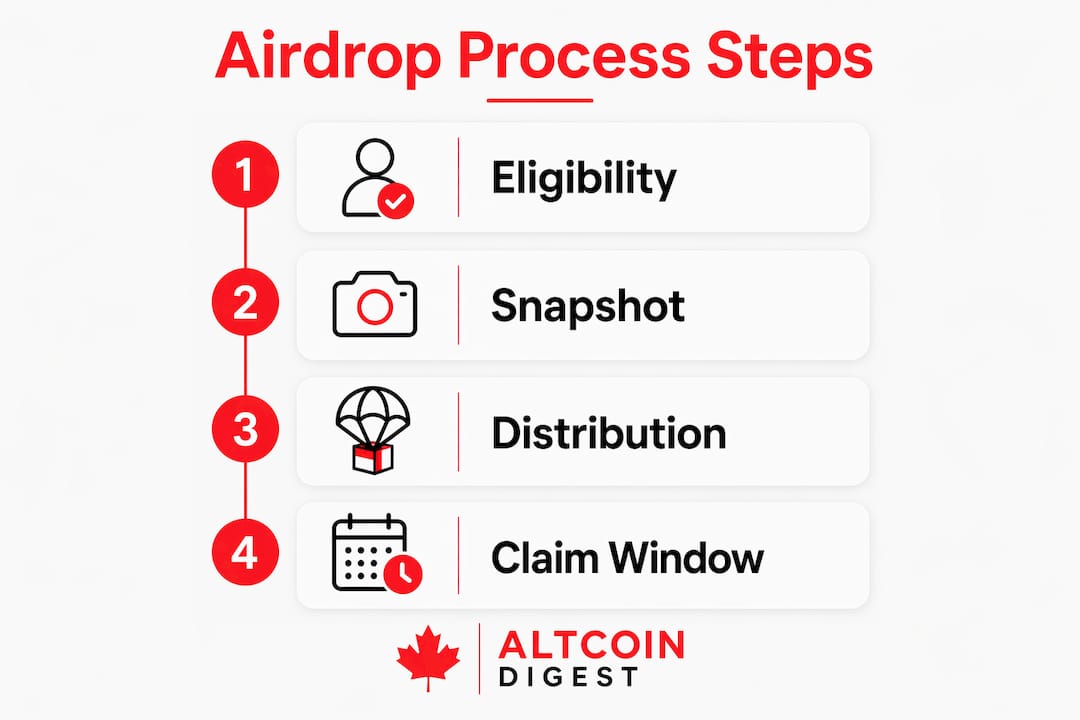
A crypto airdrop follows a structured four-step process: eligibility determination, snapshot recording, distribution or claim period, and post-airdrop market activity. Each step has distinct mechanics that affect whether you receive tokens and how much they are worth.
Step 1: eligibility criteria
Eligibility is commonly based on holding specific assets, using a protocol before a set date, or meeting behaviour thresholds such as transaction volume. Uniswap’s 2020 UNI airdrop, for example, rewarded any wallet that had interacted with the protocol before september 1, 2020. Some projects require simple tasks like following a social media account or joining a community channel. Qualification can be retroactive, meaning your past on-chain activity may already make you eligible without any additional action.
Step 2: the snapshot
A snapshot is a recorded state of the blockchain at a precise moment in time. The project captures which wallets hold qualifying assets or have completed qualifying actions at that exact block height. Investors who plan ahead and hold relevant tokens before a snapshot date stand a much better chance of qualifying. Eligibility is often based on activity at these snapshot moments, which means retroactive preparation is the only reliable strategy.

Step 3: distribution and claiming
Some airdrops deposit tokens directly into eligible wallets automatically. Others require recipients to visit an official claim portal and sign a wallet transaction to receive their allocation. Many airdrops require users to sign transactions during the claim period to prove entitlement without exposing private keys. Large distributions often use Merkle-tree cryptographic proofs, a technique that enables efficient on-chain verification without storing a full recipient list on the blockchain. This reduces data storage costs and prevents duplicate claims.
Step 4: claim windows
Claim windows are time-bounded. Unclaimed tokens typically revert to the project treasury after the window closes, which usually lasts anywhere from several months to approximately one year. Missing a claim window means forfeiting the allocation permanently. Monitoring official project channels and setting calendar reminders are the most reliable ways to avoid this outcome.
Pro Tip: Set up a dedicated wallet tracker using tools like Zapper or DeBank to monitor your on-chain activity across multiple protocols. This gives you a clear picture of which projects you have interacted with and where snapshot eligibility may apply.
What are the benefits of a crypto airdrop for projects and recipients?
Airdrops in cryptocurrency serve strategic purposes for both the issuing project and the receiving investor. Understanding both sides clarifies why this distribution method has become a standard launch and growth tool across the industry.
For projects, the primary benefits include:
-
Adoption growth: Distributing tokens to active users creates an immediate base of stakeholders who have a financial incentive to promote and use the protocol. Projects use airdrops as community-building and launch strategies to quickly establish token holders and markets.
-
Decentralisation of governance: Spreading governance tokens across thousands of wallets reduces concentration risk and supports the claim that a protocol is genuinely decentralised. Uniswap’s UNI distribution is the most cited example of this approach working at scale.
-
Liquidity bootstrapping: New tokens need buyers and sellers to function as markets. Airdrops seed that initial liquidity by placing tokens in the hands of users who may trade, stake, or provide liquidity immediately after distribution.
For recipients, the benefits and risks are equally real:
-
Free token acquisition: Recipients gain exposure to a new asset at zero direct cost, with potential for value appreciation if the project succeeds.
-
Governance participation: Holding governance tokens grants voting rights on protocol decisions, which carries real influence in decentralised autonomous organisations (DAOs).
-
Scam exposure: Fraudulent airdrop announcements are common. Fake portals mimic legitimate projects and attempt to steal wallet credentials or drain funds through malicious contract approvals.
-
Token value uncertainty: Many airdropped tokens lose significant value shortly after distribution as recipients sell immediately, a pattern sometimes called “airdrop farming.”
Pro Tip: Research the project’s tokenomics and vesting schedules before claiming. A token with a large unlocked supply and no utility often drops sharply in the weeks after an airdrop.
What tax implications do canadians face with crypto airdrops?
The Canada Revenue Agency (CRA) treats cryptocurrency as a commodity, and crypto token distribution through airdrops is no exception to its reporting requirements. Canadian investors need to understand two distinct taxable events that airdrops can trigger.
| Tax Event | When It Occurs | What Is Taxed |
|---|---|---|
| Income inclusion | When you gain control of the tokens | Fair market value of tokens at the moment of receipt |
| Capital gain or loss | When you later sell or dispose of the tokens | Difference between proceeds and the adjusted cost base |
| Gas fee consideration | At the time of claiming | Claiming costs may be deductible as part of the cost base |
Airdrops are taxable as ordinary income based on fair market value at the moment control is gained. That figure becomes your adjusted cost base for future capital gains calculations. The critical nuance is the control point. Tokens become taxable when transferable to the recipient, not when announced or visible in a notification. A token that appears in your wallet but cannot yet be transferred does not trigger a taxable event until that restriction lifts.
Gas fees paid to claim tokens on networks like Ethereum add to your cost base, which can reduce capital gains when you eventually sell. Canadian investors should maintain detailed records of the token’s fair market value on the date of receipt, the amount of gas paid, and the date of any subsequent disposal. Consulting a tax professional with cryptocurrency experience is the most reliable way to handle airdrop reporting accurately, particularly when multiple airdrops occur within a single tax year.
How to safely claim crypto airdrops and avoid scams
Security is the most consequential factor when participating in any token distribution event. The financial upside of a legitimate airdrop can be entirely erased by a single interaction with a fraudulent contract.
Core safety practices for claiming airdrops:
-
Verify official sources first. Cross-reference the claim portal URL against the project’s official website, verified social media accounts, and community channels like Discord or Telegram. A single character difference in a URL can redirect you to a phishing site.
-
Never share your seed phrase. Legitimate claims require only wallet transaction signatures, never your seed phrase or private key. Any portal requesting this information is fraudulent without exception.
-
Review token approvals carefully. Some malicious contracts request infinite or excessive token approvals, granting them ongoing access to your wallet’s assets. Use tools like Revoke.cash to audit and revoke unnecessary approvals after claiming.
-
Confirm network and contract authenticity. Best claiming practice includes verifying contract authenticity and avoiding excessive token approvals. Check the contract address against the project’s official documentation before signing any transaction.
-
Use a dedicated claiming wallet. Keeping a separate wallet with minimal assets for interacting with new or unverified contracts limits your exposure if something goes wrong.
Pro Tip: Use a hardware wallet like a Ledger or Trezor when claiming high-value airdrops. Hardware wallets require physical confirmation of every transaction, which prevents remote approval of malicious contracts even if your computer is compromised.
Key takeaways
A crypto airdrop is a structured token distribution mechanism that rewards eligible wallet holders with free tokens, but successful participation requires preparation, security awareness, and tax compliance.
| Point | Details |
|---|---|
| Definition and purpose | Airdrops distribute free tokens to eligible wallets to grow adoption, decentralise governance, and bootstrap liquidity. |
| Eligibility and snapshots | Qualification is based on past on-chain activity at a snapshot moment, so planning ahead is the only reliable strategy. |
| Claiming mechanics | Most airdrops require a wallet signature during a time-bounded window; unclaimed tokens revert to the project treasury. |
| Canadian tax obligations | Airdropped tokens are taxable income at fair market value upon receipt, with capital gains applying on later disposal. |
| Security best practices | Always verify official portals, never share seed phrases, and use a hardware wallet for high-value claims. |
Airdrops are incentive design, not free money
I have tracked dozens of airdrop cycles since the early days of DeFi, and the single most persistent misconception I encounter is that airdrops are simply free money. They are not. They are designed incentives targeting specific on-chain behaviour to shape token distribution and liquidity in ways that benefit the issuing project. Uniswap did not distribute UNI out of generosity. It distributed UNI to lock in a user base and establish decentralised governance before competitors could replicate its model.
The investors who benefit most from airdrops are those who treat protocol participation as a deliberate strategy rather than a passive activity. Using a new DeFi protocol, providing liquidity, or holding a specific NFT collection are all forms of on-chain behaviour that projects reward retroactively. If you wait until an airdrop is announced to start participating, you have almost certainly missed the snapshot.
The tax and security dimensions are where I see the most avoidable mistakes. Canadians who receive airdropped tokens and sell without recording the fair market value at receipt are setting themselves up for CRA complications. The security risk is equally real. I have seen experienced investors lose significant holdings by interacting with a contract they assumed was legitimate because it appeared in a credible-looking announcement. Verification is not optional. It is the baseline.
— Lukas Werner
Stay ahead of the next major airdrop with Altcoindigest
Knowing what a crypto airdrop is represents only the first step. The real advantage comes from tracking which projects are building toward a token launch, which protocols are accumulating active users ahead of a potential snapshot, and which distributions are currently live.

Altcoindigest publishes timely crypto market analysis covering token launches, protocol developments, and regulatory shifts that affect Canadian investors directly. Whether you are monitoring an upcoming distribution or assessing the post-airdrop price behaviour of a newly listed token, Altcoindigest provides the focused, factual reporting you need to make informed decisions. Visit Altcoindigest to stay current on the developments that matter most to your portfolio.
FAQ
What is a crypto airdrop in simple terms?
A crypto airdrop is the free distribution of tokens or NFTs to wallet addresses that meet specific eligibility criteria, such as holding a particular asset or having used a protocol before a set date. Projects use airdrops to grow their user base and distribute governance rights.
How do i know if i am eligible for a crypto airdrop?
Eligibility is typically determined by a snapshot of your on-chain activity at a specific block height. Using DeFi protocols, holding qualifying tokens, or participating in a project’s community before the snapshot date are the most common qualifying conditions.
Are crypto airdrops taxable in canada?
Yes. The CRA treats airdropped tokens as taxable income at their fair market value on the date you gain control of them. A second taxable event, either a capital gain or loss, occurs when you later sell or dispose of the tokens.
Can you earn meaningful returns from crypto airdrops?
Recipients can earn significant returns if the distributed token appreciates in value after launch. Uniswap’s UNI airdrop, for example, delivered thousands of dollars in value to eligible wallets at the time of distribution. Returns are not guaranteed and depend entirely on the project’s subsequent performance.
What is the safest way to claim a crypto airdrop?
Always use the project’s official claim portal, verify the contract address against official documentation, and never share your seed phrase. Using a hardware wallet and a dedicated claiming wallet with minimal assets reduces your exposure to malicious contracts significantly.