
Accepting cryptocurrency business payments means enabling your business to receive digital currencies such as Bitcoin, Ether, and stablecoins like USDC and USDT, either directly or through third-party payment providers. The practice has moved well beyond early adopters. Providers like Stripe and Square now offer merchant-facing tools that make crypto acceptance as operationally manageable as card processing. For small business owners, the core benefit is straightforward: you expand your payment options, reduce cross-border transaction friction, and position your business to serve a growing segment of customers who prefer digital assets.
How to accept cryptocurrency business payments
Businesses typically choose between three main models to receive crypto: payments platforms with built-in support, dedicated crypto payment gateways, or direct receipt via self-managed wallets. Each model carries distinct trade-offs in operational complexity, cost, and control. Many businesses ultimately adopt a hybrid approach, combining elements of more than one method.
Payments platforms with built-in crypto support
Stripe and Square represent the clearest entry point for most small businesses. These platforms handle the blockchain mechanics and fiat settlement on your behalf, meaning you receive local currency in your account while your customer pays in crypto. The operational lift is minimal, and the compliance burden shifts largely to the provider.

Dedicated crypto payment gateways
Dedicated gateways track on-chain payments and offer optional fiat conversion at the point of settlement. They give merchants more visibility into individual transactions and often support a broader range of cryptocurrencies. The trade-off is a more involved setup and a greater need to understand on-chain reconciliation.
Direct acceptance via self-managed wallets
Direct acceptance requires you to manage your own private keys and wallet infrastructure. This model offers maximum control and eliminates provider fees, but it places the full weight of security, compliance, and reconciliation on your team. It suits businesses with technical capacity and a deliberate treasury strategy around holding digital assets.
| Model | Control Level | Setup Complexity | Compliance Burden |
|---|---|---|---|
| Payments platform (Stripe, Square) | Low | Low | Mostly on provider |
| Dedicated crypto gateway | Medium | Medium | Shared |
| Self-managed wallet | High | High | Fully on business |
What tools and prerequisites do you need?
The foundational requirement for any crypto payment setup is a wallet, either custodial or non-custodial. A custodial wallet is managed by a third party, such as a provider dashboard. A non-custodial wallet gives you direct control over private keys. Some providers offer built-in wallets managed through their platform dashboards, which removes the need to handle private key infrastructure entirely.
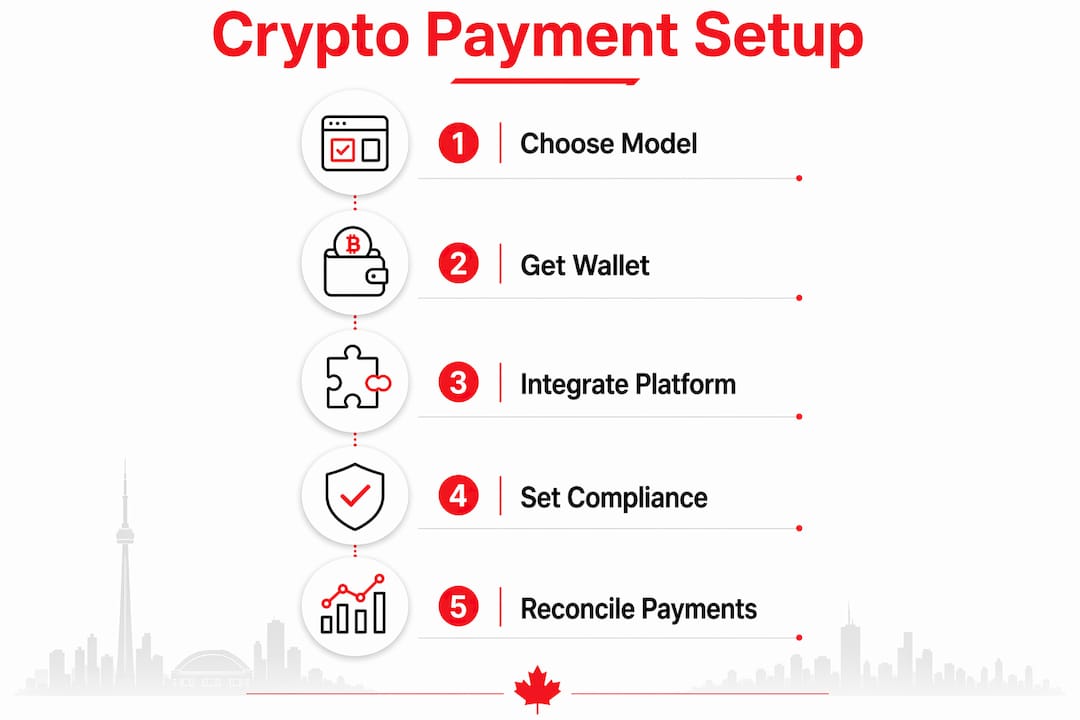
Integration is typically a simple API call or plugin for e-commerce platforms, with dynamic pricing locking exchange rates briefly to reduce volatility exposure. This means the price your customer sees in crypto is fixed for a short window, usually 10–15 minutes, protecting both parties from sudden market moves. That mechanism counters one of the most common objections to crypto payments: price instability at the point of sale.
The recommended starting currencies are Bitcoin, Ether, and stablecoins like USDC and USDT, chosen for their liquidity and relative stability. Stablecoins in particular carry lower volatility risk because they are pegged to fiat currencies, making them practical for everyday transactions.
- Custodial wallet: Managed by provider; lower technical burden; less direct control
- Non-custodial wallet: You hold private keys; full control; requires security discipline
- API or plugin integration: Connects your checkout or POS to the payment provider
- Dynamic pricing: Locks exchange rates per transaction to limit volatility exposure
- Supported currencies: Start with BTC, ETH, USDC, and USDT for broadest compatibility
Pro Tip: If you are new to crypto payments, start with a custodial solution through an established provider like Stripe or Square. You can migrate to a self-custody model later once you understand your transaction volume and reconciliation needs.
How to integrate crypto payments into your operations
Integration follows a logical sequence. Working through each step carefully prevents the operational gaps that cause reconciliation problems later.
- Select your model. Decide whether you will use a payments platform, a dedicated gateway, or a self-managed wallet. Base this on your technical capacity and how much compliance work you are prepared to manage internally.
- Connect to your checkout or POS. For e-commerce, install the provider's plugin or make the API call to your existing platform. For physical retail, confirm your POS system supports crypto tender or use a separate terminal.
- Display pricing clearly. Show prices in both fiat and crypto at checkout. Customers need to see the fiat equivalent to make informed purchasing decisions, and this practice also supports your own record-keeping.
- Set exchange rate lock windows. Configure your provider's dynamic pricing settings to lock rates for each transaction. This protects your revenue from price swings during the payment window.
- Decide on conversion or holding. Deciding whether to convert immediately or hold crypto affects your wallet security requirements, treasury management approach, and customer communication policies. Most small businesses convert to fiat immediately to avoid balance sheet volatility.
- Reconcile on-chain transactions. Match each on-chain payment to your business records. The complexity of reconciling on-chain payments with financial systems is frequently underestimated. Providers simplify this through dashboard reporting, but you still need a clear internal process.
Pro Tip: Set a weekly reconciliation cadence from day one. Waiting until month-end to match on-chain transactions with your accounting records creates compounding errors that are difficult to unwind.
What compliance and tax obligations apply to your business?
Compliance is the area where small business owners most often underestimate the ongoing commitment. Accepting Bitcoin is legal in most jurisdictions without a special licence for receiving payments, but local rules vary and should be confirmed before launch. In Canada, the Financial Transactions and Reports Analysis Centre of Canada (FINTRAC) imposes registration requirements on businesses that exchange or transfer virtual currencies as a core activity. Simple receipt of crypto as payment generally falls outside that threshold, but the line warrants legal review.
Tax obligations are non-negotiable regardless of jurisdiction. U.S. tax guidance requires recognition of fair market value at the time of crypto receipt, reported as gross income. Any gain or loss realised when the crypto is later sold or exchanged is treated as a capital event. In Canada, the Canada Revenue Agency applies similar principles: the fair market value at receipt is business income, and subsequent disposition triggers a capital gain or loss calculation.
"No special licences are generally required for simple crypto payment receipt, but holding and exchanging dynamics trigger regulatory obligations. Onboarding is only the first step of compliance." — Square, 2026
The IRS now requires Form 1099-DA reporting from exchanges, increasing the data available for tax compliance enforcement. This development signals a broader regulatory direction: authorities are building the infrastructure to cross-reference business income declarations with on-chain data. Businesses that treat crypto receipts as off-book revenue face material audit risk.
Providers like Stripe and Square assist with Know Your Customer (KYC) and Anti-Money Laundering (AML) obligations, reducing the direct compliance burden on merchants. However, if you hold crypto in a self-managed wallet, the full weight of those obligations rests with you.
- Tax reporting: Record fair market value at receipt; track cost basis for future disposition
- KYC and AML: Providers handle this for platform-based acceptance; self-custody requires your own processes
- Wallet security: Use hardware wallets for significant holdings; enable multi-factor authentication on all accounts
- Volatility mitigation: Convert to fiat at settlement, or use stablecoins to limit balance sheet exposure
- Regulatory monitoring: State-by-state compliance nuances require ongoing regulatory review, not a one-time onboarding check
Key takeaways
Accepting cryptocurrency payments requires choosing the right model, setting up proper tools, and maintaining ongoing compliance, not just completing a one-time technical integration.
| Point | Details |
|---|---|
| Three core acceptance models | Choose between payments platforms, dedicated gateways, or self-managed wallets based on your capacity. |
| Start with major currencies | BTC, ETH, USDC, and USDT offer the best liquidity and provider support for new adopters. |
| Dynamic pricing reduces volatility risk | Exchange rate lock windows protect revenue during the payment window without manual intervention. |
| Tax obligations begin at receipt | Record fair market value when crypto is received; capital gains apply on any later disposition. |
| Providers reduce compliance burden | Routing payments through Stripe or Square shifts KYC, AML, and reconciliation complexity to the provider. |
Choosing control over convenience: a pragmatic view
By Lukas
The most common mistake I see small business owners make when setting up crypto payments is treating it as a purely technical project. They focus on the plugin installation or the API key and consider the job done. The operational and compliance layer is where the real work begins.
My honest assessment is that most small businesses benefit operationally from routing payments through an established provider, at least initially. The appeal of self-custody is real: lower fees, full control, no intermediary. But for a business processing a few hundred transactions a month, the reconciliation overhead and security requirements of self-managed wallets frequently outweigh the savings. A hardware wallet breach or a mismanaged private key is not a recoverable situation.
The volatility concern is also more manageable than most people assume. Dynamic pricing and exchange rate locking effectively neutralise the price instability problem at the point of sale. The residual risk is in holding, not in receiving. If you convert to fiat at settlement, your exposure is limited to the seconds between payment confirmation and conversion.
What I would caution against is treating compliance as a one-time checkbox. Regulatory frameworks for crypto are evolving in Canada, the United States, and most other jurisdictions. The businesses that manage this well are the ones that build compliance review into their quarterly operations, not just their initial setup. That discipline is what separates businesses that scale their crypto payment programmes from those that quietly abandon them after the first audit notice.
— Lukas
Stay informed with Altcoindigest
Regulatory frameworks and market conditions for crypto payments shift frequently. Staying current is not optional for businesses that accept digital currencies as a meaningful part of their revenue.
Altcoindigest provides focused crypto market analysis covering regulatory developments, payment technology updates, and market movements relevant to Canadian businesses and entrepreneurs. Whether you are monitoring FINTRAC guidance, tracking Bitcoin price trends that affect your settlement strategy, or watching for new payment provider announcements, Altcoindigest crypto news delivers the context you need to make informed decisions. Bookmark the site and check it regularly as part of your compliance and treasury management routine.
FAQ
What is the easiest way to accept crypto payments?
The easiest method is using a payments platform like Stripe or Square, which handles blockchain mechanics, fiat settlement, and much of the compliance work on your behalf. Setup typically requires only an API call or e-commerce plugin installation.
Do small businesses need a special licence to accept bitcoin?
Accepting Bitcoin as payment generally does not require a special licence in most Canadian and U.S. jurisdictions, but businesses that exchange or transfer virtual currencies as a core activity may trigger registration requirements under FINTRAC or state-level regulations.
How are crypto payments taxed for businesses?
The fair market value of crypto received is recognised as business income at the time of receipt. Any gain or loss on a later sale or exchange of that crypto is treated as a capital event, requiring separate tracking of cost basis.
Which cryptocurrencies should a small business accept first?
Bitcoin, Ether, USDC, and USDT are the recommended starting point due to their liquidity, broad provider support, and, in the case of stablecoins, lower price volatility relative to other digital assets.
How does dynamic pricing protect against crypto volatility?
Dynamic pricing locks the exchange rate for a short window, typically 10–15 minutes, at the time a customer initiates payment. This protects the merchant from price swings during the transaction and gives the customer a fixed crypto amount to send.